Integration: enhancing Project 13 success
The integration pillar of Project 13 extends beyond people to systems and processes: common purpose and objectives, a collaborative culture, integrated systems that let data flow to decisions, engaged stakeholders with real ownership, and continuous improvement through captured lessons. These principles are easy to agree with and hard to live — unless the platform underneath makes them the default behaviour.
Integration is architectural, not aspirational
In UniPhi, the platform's modules — documents, issues, risks, costs and budgets, contracts, schedule and time, resources, sign-offs, site capture, communication, methodology and reporting — all operate against a single portfolio database. A design issue raised on site links to the drawing revision it affects, the variation it may cause, the budget movement that follows and the sign-off that authorises it. Everything rolls up and down for consolidated, live reporting across project, programme and portfolio, and the resource module places every stakeholder at exactly the right level of involvement, with reassignments handled in moments as roles change.
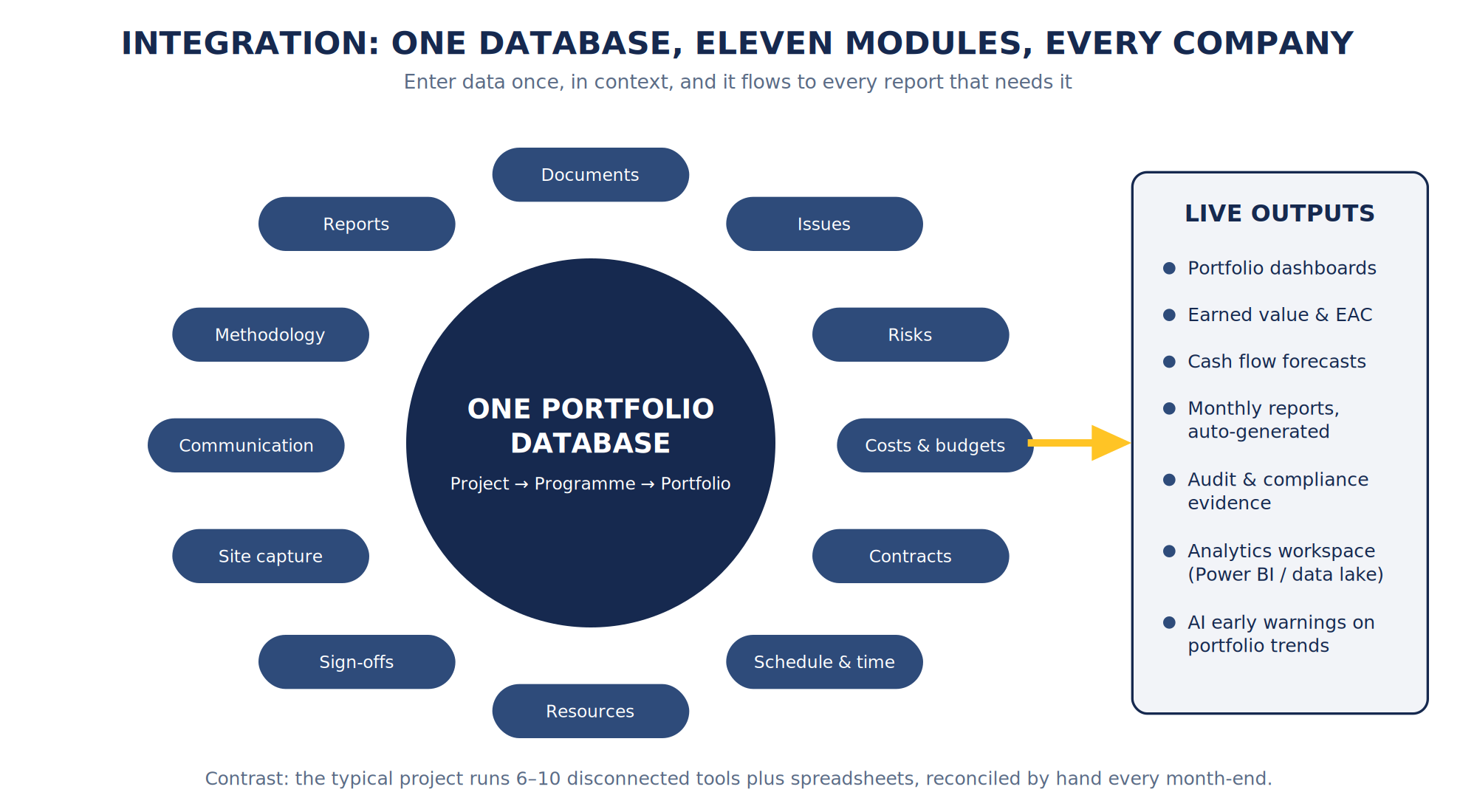
UniPhi's eleven modules around one portfolio database, flowing to live dashboards and analytics
The contrast with typical practice
Most projects run six to ten disconnected tools plus spreadsheets, reconciled by hand at every reporting cycle. Integration in that world is a person with a pivot table. Integration in UniPhi is simply how the data model works — which is why problems get resolved in the issues module before they become blowouts, and why reporting takes minutes rather than the second week of every month.
Enter data once, in context, and it flows to every report that needs it. That is the integration pillar made routine.
This post is part of our Project 13 series. Start with the complete guide to Project 13, or read the next pillar: Digital Transformation. Contact sales@uniphi.com.au for a walkthrough of the integrated data model.