Project 13: the complete guide for asset owners
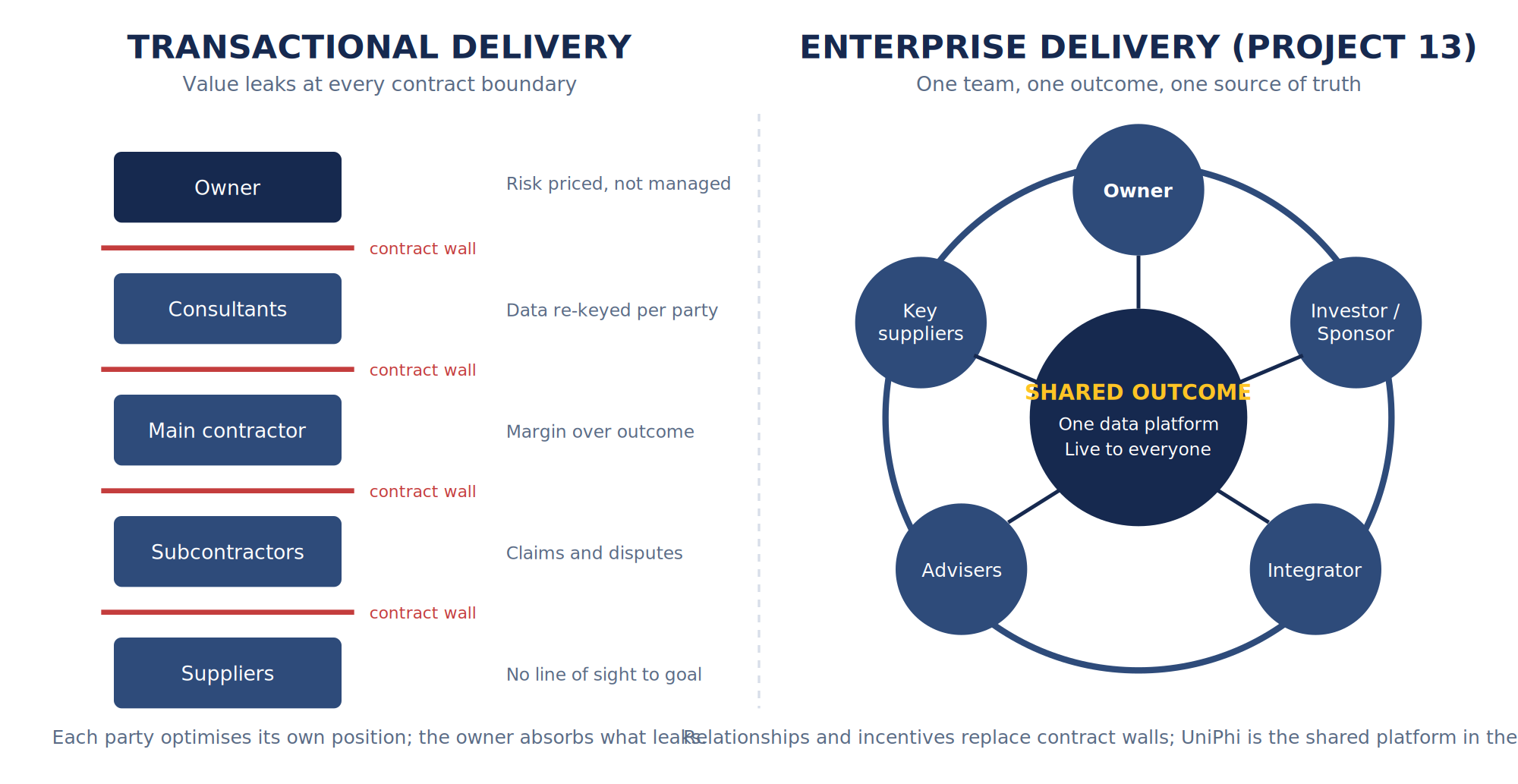
Construction and infrastructure remain among the most adversarial project environments in any industry. Each organisation on a project is, quite rationally, in it for itself. Risk is priced rather than managed, data is re-keyed at every organisational boundary, and the parties that "win" often do so at the considerable expense of others — with the biggest loser usually being the owner of the asset being built.
The industry has tried to contract its way out of this problem for decades. The NEC suite, early contractor involvement, alliancing and PPP structures all attempt to force parties together earlier and more often. Their success is real but limited, because each remedy is still centred on the contract itself.
What Project 13 is
Project 13 takes a different route. Launched in 2018 by the Infrastructure Client Group under the Institution of Civil Engineers, and building on the ICE report From Transactions to Enterprises, it asks owners to stop procuring projects as a series of transactions and instead to build a long-term enterprise: owner, investor, integrator, advisers and key suppliers organised around shared outcomes, with rewards linked to value added rather than volume transacted.
Project 13 has moved well beyond theory. An international adopter community now includes major infrastructure owners such as Anglian Water's @one Alliance, National Grid, Sellafield and the Environment Agency, and the thinking is embedded in the UK's Construction Playbook and the Transforming Infrastructure Performance: Roadmap to 2030 agenda.
The five pillars
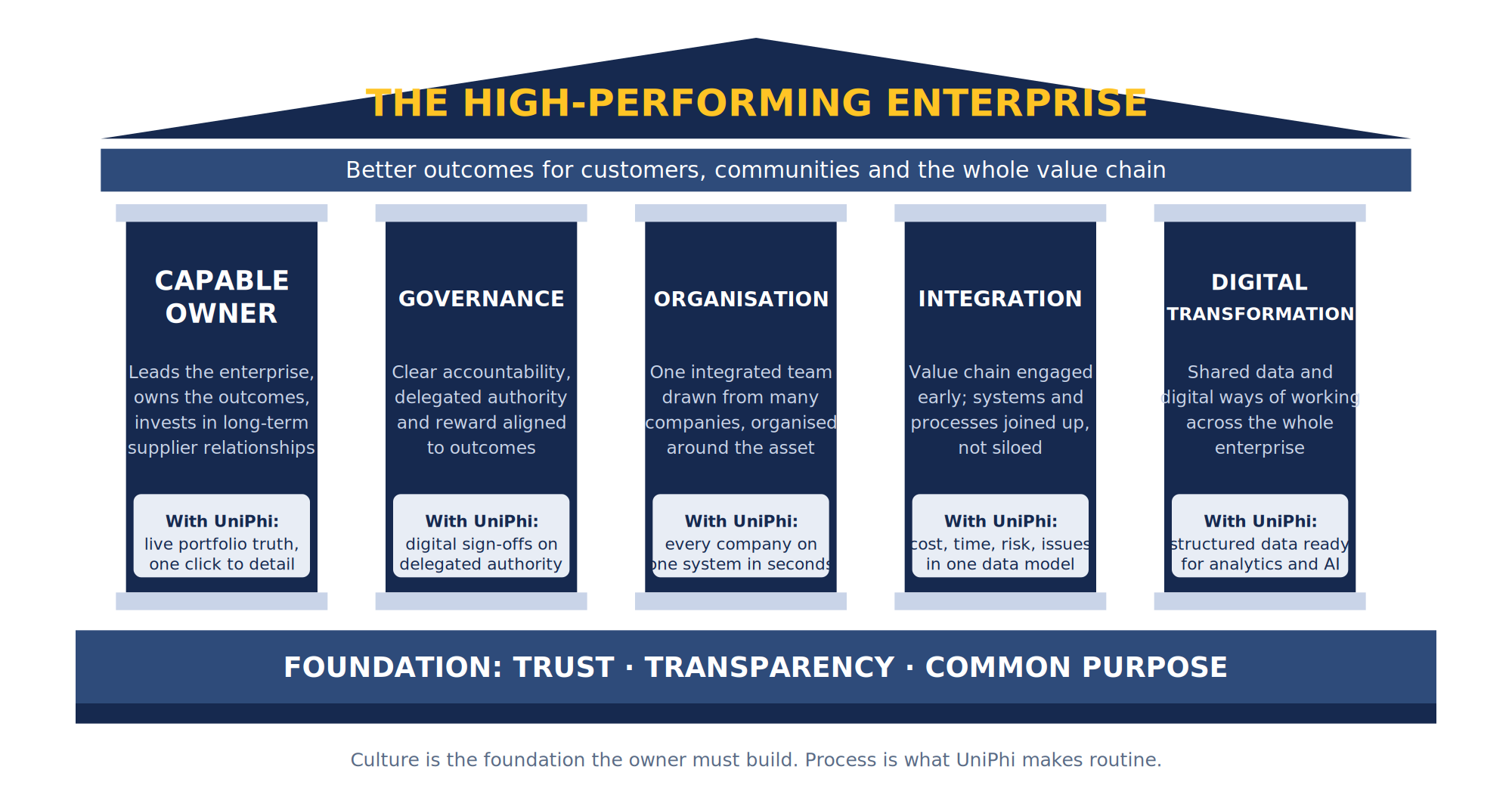
Project 13 is structured around five pillars, each with principles that guide an enterprise toward high performance, standing on a cultural foundation of trust, transparency and common purpose. We've written a detailed guide to implementing each pillar:
- The Capable Owner — the foundation pillar, and the hardest: long-term relationships, line of sight, and leadership of the enterprise.
- Governance — clear accountability and delegated authority, evidenced automatically rather than policed.
- Organisation — one integrated team drawn from many companies, working in one system.
- Integration — systems and processes joined up so data flows to decisions.
- Digital Transformation — shared data and digital ways of working across the whole enterprise.
Where UniPhi fits
The hardest part of Project 13 is cultural: building genuine trust, transparency and common purpose between an owner and its supply chain. No software can do that for you. But once the cultural intent exists, the day-to-day challenge becomes one of process — and process is exactly what a well-designed system makes routine.
UniPhi's founding principles map almost one-for-one onto Project 13: transparency of information; integration of cost, time, quality, risk and issue data in one model; access anywhere, at any time, for any organisation. The simplest thing UniPhi does is also the most radical in this industry — it onboards any team member from any company in seconds and has them collaborating in a single, transparent data architecture.
Culture is the foundation the owner must build. Process is what UniPhi makes routine.
Much has changed since Project 13 launched — including what your project data is now worth in the AI era. Read what's changed, and why it matters more than ever.
Ready to see what a Project 13 enterprise looks like on your own portfolio? Contact us at sales@uniphi.com.au.