The capable owner: Project 13's foundation pillar
The capable owner is the foundation pillar of Project 13 — and by far the hardest to achieve. Traditional practice worldwide is to establish an adversarial contractual relationship and staff it with commercial specialists whose job is to make sure their side wins a win/lose contest. A capable owner deliberately breaks that pattern by developing long-term business relationships built on trust and transparency, where the partnership comes first and the contract second. The contract should exist for the event of divorce; it should never be the management document that runs the project.
The value on the table
The prize is substantial. Administration shrinks, re-work falls, planning improves, and a genuine focus on outcomes drives down the whole-of-life cost of the asset, not just the capital cost. If that value is then shared fairly along the chain, relationship bonds strengthen and the next investment unlocks even more — a compounding return that transactional delivery can never produce. To grey-haired industry veterans this can sound like pie in the sky; our observation is simply that the owners who get there first, together with their suppliers, are swimming in blue ocean.
Capability means line of sight
What makes an owner capable in practice is not a job title. It is the ability to see, at any moment, an accurate picture of cost, schedule, risk and issues across the portfolio — and to act on it before positions harden into claims.
UniPhi gives owners exactly that page: live earned value with instant estimate-at-completion forecasts, the key issues and risks currently being worked, milestones just achieved and about to fall due, resources near capacity, and the supply contracts that must be let for long-lead items to land on time. Every number is one click away from the transactional data and the conversation behind it.
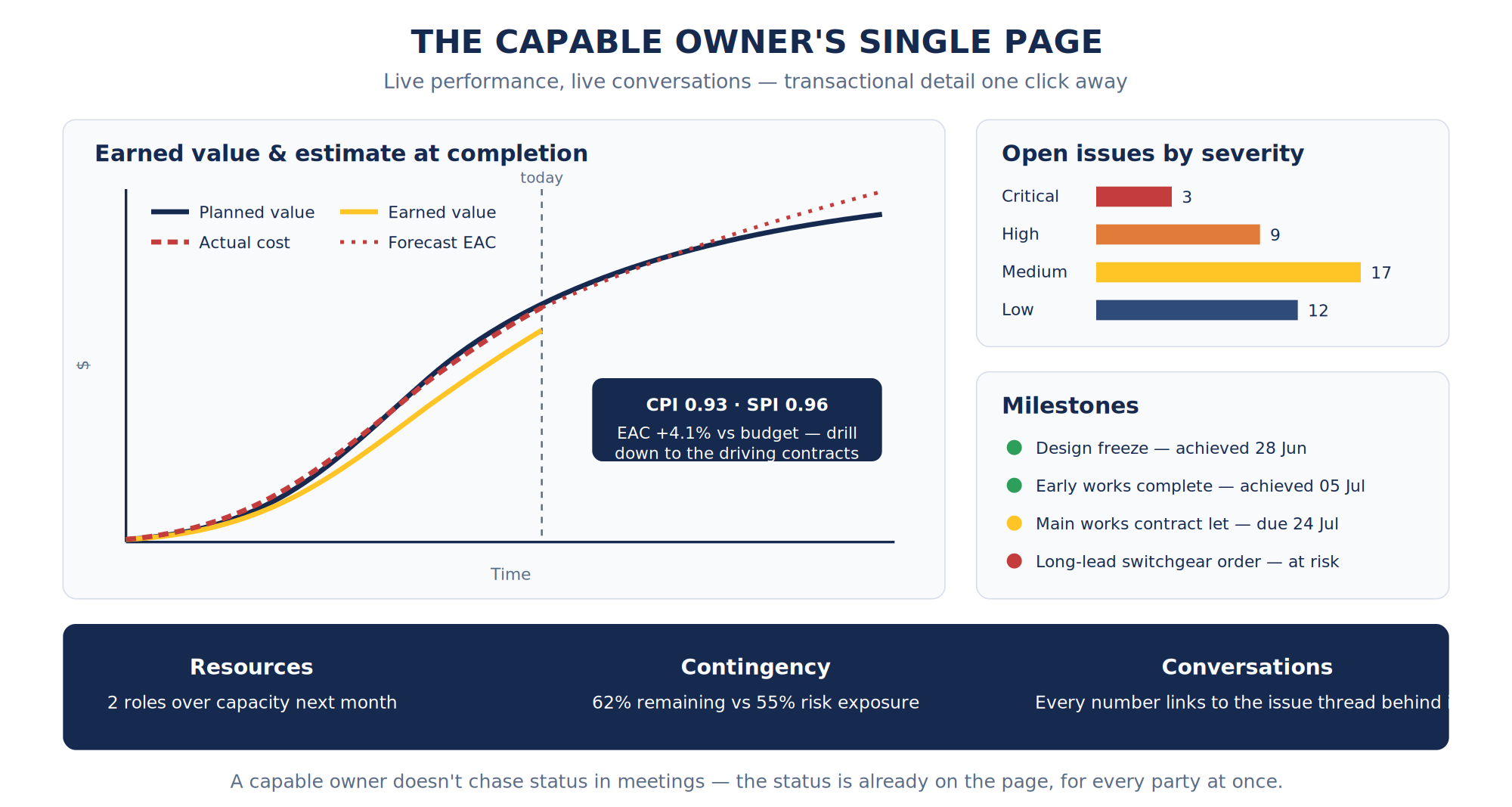
UniPhi dashboard showing earned value, issues, milestones and contingency for a capable asset owner
The engine room: shared issues
Unlike collaboration tools that have effectively paved a cow path over the RFI, UniPhi's issues and risks modules give multiple companies a shared place to raise, comment on, rate and escalate the items that genuinely endanger the outcome. It is the simplest module in the platform, and yet it is the engine room of an integrated team — the mechanism through which a complex, multi-company organisation adapts before problems become claims.
A capable owner doesn't chase status in meetings. The status is already on the page, for every party at once.
This post is part of our Project 13 series. Start with the complete guide to Project 13, or read the next pillar: Governance. To see the capable owner's single page on your own portfolio, contact sales@uniphi.com.au.