Governance: a workflow, not a police state
Governance in a Project 13 enterprise is not about policing progress reports. It is about clear accountability, delegated authority and incentives aligned to outcomes — and about being able to demonstrate, at any time, that the system you designed is the system actually being followed.
Every dollar follows one controlled path
UniPhi approaches this as a workflow problem. Original budgets are approved by digital signature against configurable delegations of authority. Contracts are awarded within those same delegation limits, with the documentation auto-generated from the modules that captured the data in the first place. Variations and change requests are linked to the issues that caused them and the budget movements they create. Progress claims travel one controlled path from supplier to project manager to accountant to the accounting system.
At every gate there is a digital signature; behind every signature there is a delegation; and beneath the whole flow sits a continuous audit trail generated as a by-product of doing the work.
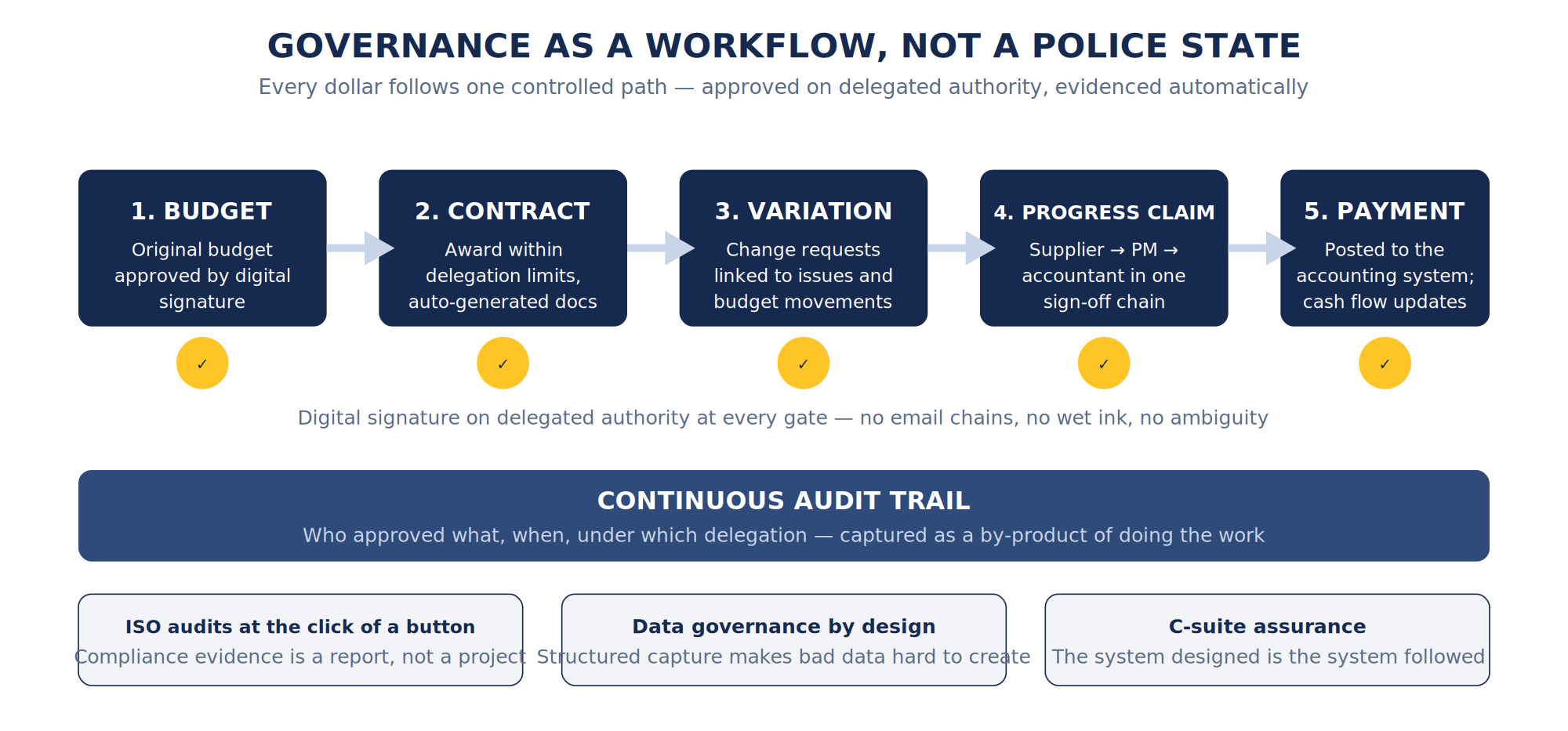
Project 13 governance workflow in UniPhi: budget, contract, variation, progress claim and payment gated by digital signatures
Two under-appreciated consequences
The first is data governance by design. Because UniPhi is a structured system, users follow the bouncing ball of document version control, variation management and issue management, and data is captured in context. You have to work very hard to get bad data out the other end — which matters more than ever now that this data feeds analytics and AI (more on that in what's changed since 2022).
The second is audit economics. ISO, government policy and financial audits at our clients have become a matter of running reports rather than mounting an evidence-gathering expedition — saving thousands in compliance cost while giving directors and executives genuine, rather than asserted, assurance.
If you are a project director or a C-suite executive who likes to sleep at night, this pillar alone justifies a look — Project 13 or not.
This post is part of our Project 13 series. Start with the complete guide to Project 13, or read the next pillar: Organisation. Contact sales@uniphi.com.au to see governance workflows configured to your delegations.